

TU Law History
At Temple, we believe that some things just have to be learned by doing. You can't learn to ride a bicycle by reading a manual, you can't learn how to be a lawyer by watching even the best of lawyers, and you can't improve if mistakes are only imagined. At Temple, students don't just read, watch, or imagine. They do that and more-they do the work of attorneys. It sounds simple but it works.
Temple University's Beasley School of Law offers a different kind of law school experience: a Real World, Real Law experience that incorporates academic and practical applications of legal study into rigorous classroom experiences.
Temple's faculty is comprised of a distinguished group of experienced attorneys who are continually recognized throughout the world as legal experts. Their advice and commentary is sought on issues ranging from organized crime to the stock market to e-commerce. Temple's faculty continually develops new and creative methods of instruction and brings the real world to the classroom. While their accomplishments are many, it is their commitment to teaching that most students note as their greatest achievement.
Temple students are given numerous opportunities to apply their textbook knowledge in practical settings at law firms, in courtrooms, for community and civic organizations, and in business and financial institutions in the City of Philadelphia and beyond. As students, they are poised and ready to succeed in every sector of the legal job market, having acquired a unique combination of practical training and job skills that other schools don't offer. As graduates, they carry a strong reputation for being able to hit the ground running, confident and prepared to practice law in the field of their choice.
Temple alumni are partners and associates at every type of law firm from multi-national offices to rural solo practices. Temple graduates are sought after to work as district attorneys and public defenders in large and small cities all over the United States. They head large non-profit agencies and staff legal aid offices. They also serve as legal counsel for Fortune 500 companies and a multitude of small- and medium-sized corporations.
Whether you are interested in practicing in a traditional law firm, a public interest organization, or a high tech corporation, Temple's cutting edge approach to legal education will prepare you for every facet of the exciting and ever-changing world of 21st century legal practice.
History of the Law School
Temple University was founded in 1884 by Russell H. Conwell, the University's first president. He was a famed orator, who raised millions of dollars for the school with his classic "Acres of Diamonds" speech which urged audiences to find riches in their own backyards.
In May 1895, Dr. Conwell met with Henry S. Borneman, a young lawyer and lecturer in the University's Business College. Borneman wanted to establish an evening course of study in the law. With some doubts, Conwell agreed.
The first classes were held in College Hall, Broad and Berks Streets, Temple's first academic building. Forty-six students enrolled in the evening division, paying tuition of $12 a semester.
William A. Shoemaker was the first principal of the Law School. Borneman was named principal in 1896 and became the first dean the following year. On April 2, 1901, 16 students, all previously admitted to the bar, graduated from The Philadelphia Law School of the Temple College.
The Law School's second dean was William Alexander Brown, who served from 1902 to 1905. He was followed by Francis Chapman, who was dean pro tem from 1905 to 1907 and then dean until his death in 1939.
In 1910, the Law School made the first of several migrations, moving to the second and third floors of the Wilson Building, over a shoe repair shop at 16th and Sansom Streets. A year later, the institution was named, The Temple University School of Law.
By 1922, the Law School was located at 1521 Locust Street, also home to the Temple School of Music, where students heard lectures on the law set to the sounds of nearby music. The first issue of The Temple Law Quarterly was published in 1927.
The Law School's next home, from 1928 to 1938, was the Public Ledger Building on Independence Square. Here the roar of the Public Ledger presses nearly drowned out the legal lectures. Historical moments included creation of a three-year day division in 1933 and full accreditation from the Council on Legal Education of the American Bar Association. Two years later, the Law School was admitted to membership in the Association of American Law Schools.
In 1939, Associate Dean John G. Hervey became dean and the Law School moved once again, to the 13th floor of the Gimbel Building at Ninth and Chestnut. Hervey resigned in 1941 and Judge Charles Klein '21 was named acting dean. Elden S. Magaw was administrator of the Law School from 1942 to 1947 and served later as assistant and associate dean. In 1947 Benjamin Franklin Boyer was appointed dean, a post he held until 1965.
In 1948, the Law School acquired the Lucas Hirst Law Library of some 20,000 books. Temple's first official Moot Court Board was organized in 1949 and competed the following year at the national competition in New York City.
In 1953, the Law School moved back to main campus, one-half block from its present location into the former building of the Congregation Keneseth Israel, renamed Reber Hall. A branch of the Philadelphia Legal Aid Society was opened in the new building. Earl Warren, Chief Justice of the United States, was keynote speaker at the dedication of Reber Hall in 1954.
The Law Library moved into the former synagogue of the Congregation Keneseth Israel, and was renamed the Charles Klein Law Library. The Temple Law Foundation was formed in 1959 as the first major fund-raising organization for the school.
Ralph Norvell was appointed dean of the Law School in 1965. He resigned in 1971 and Professor Joseph W. Marshall, Jr. '54 was named acting dean. Marshall served until Peter J. Liacouras became dean of the School of Law in 1972.
On July 25, 1972, fire destroyed the Law School library. The Law School moved to its new and permanent home in the Charles Klein Law Building at Broad and Montgomery. The Sp.A.C.E. special admissions program was created to insure a diverse and excellent student body. The 1970s saw reforms in curriculum and development of a comprehensive clinical program; graduate LL.M. degree programs, in addition to those in taxation and labor, were initiated for lawyers who wanted to teach law and for international students. Summer sessions abroad were begun in Ghana, Greece, Italy and Israel and continue today in the latter three countries.
In 1974, the Legal Aid Society branch office became the Temple Legal Aid Office and the Law, Education and Participation program was established to provide law-related education to non-lawyers. A part-time day program was started in 1975. In 1981 the Elderly Law Project began serving older persons in the Philadelphia area.
After 10 years of service, Dean Liacouras became president of Temple University in 1982. Professor Israel Packel served as acting dean until Professor Carl E. Singley '72 was appointed dean of the Law School. Singley brought a significant number of teacher-scholars to the Law School, and during his tenure Faculty Colloquia and Legal Education Seminars were begun, two new student scholarly journals were initiated, and the first issue of Temple Esq., the Law School alumni newsletter was published.
During his tenure as acting dean, from 1987 to 1989, Professor James Strazzella instituted the first permanent fund-raising program at the Law School.
On June 1, 1989, Robert J. Reinstein was named ninth dean of the Law School. That fall, the American College of Trial Lawyers presented the Law School with the prestigious Emil Gumpert Award for Excellence in Teaching Trial Advocacy. Temple was presented with the Emil Gumpert award again in 2002, for the developments in the program since the first award. Major curriculum innovations began in 1990. Among them was the Integrated Program in Trial Advocacy, a year-long program in which theory and practice are combined. In 1993, this program won the American Bar Association E. Smyth Gambrell Professionalism Award. The Integrated Business Law Program was started in 1994 and received the inaugural "Problem Solving in the Law School Curriculum Award" by the CPR Institute for Dispute Resolution.
In the past decade the Law School has received over $70 million in contributions from graduates, foundations and friends; these contributions include $60 million in cash receipts to date and over $10 million in legally binding pledges; 6 of these contributions are equal to or more than $1 million and include the largest gift ever to Temple University. The Law School's endowment has increased from $10 million to $40 million. Ten new faculty professorships have been established, and fifty-four new endowed scholarships were funded.
In 1992 the first Board of Visitors was installed. In 1993 the Masters of Trial Advocacy started and is the only graduate law program in the country in this field. In 1994, a semester-long program in Tokyo was begun as the first such program offered by any American law school in Asia.
A year-long celebration marked the Law School's 100th year in 1995 and included a Centennial Campaign. A Centennial Society was established, composed of honored donors of $100,000 and more. William H. Rehnquist, Chief Justice of the United States, received an honorary Doctor of Laws degree and was speaker at the Centennial Convocation on April 2, 1996. The Centennial Campaign raised more than $10,000,000.
The Masters in Transnational Law was started in 1998. It is a graduate program in which students study private and public international law at the main campus and at the Law School's campuses in Tokyo, Rome and Tel Aviv.
Shusterman Hall Conference Center and Barrack Hall were made possible by a $1 million donation from Murray H. Shusterman '36 and a $2.5 million donation from Leonard Barrack '68 which funded Morris and Sylvia Barrack Hall named for his parents. In 2002 The Preservation Alliance for Greater Philadelphia named Barrack Hall the winner of the 2002 Award for Adaptive Reuse. Preservation Pennsylvania and the Pennsylvania Historical and Museum Commission selected Barrack Hall to receive a 2003 Pennsylvania Historic Preservation Award.
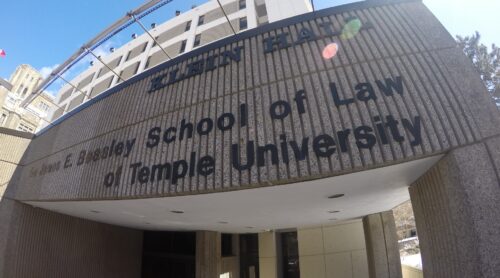
In 1999, Temple Law School received a major endowment gift from James E. Beasley '56, a distinguished Temple Law graduate and prominent litigator. This was the largest gift ever made to Temple University and one of the largest made to any American law school. In grateful recognition of the longstanding support that Mr. Beasley has given to Temple University and to its Law School, the University Board of Trustees changed the official name of Temple Law School to The James E. Beasley School of Law of Temple University. James E. Beasley died September 18, 2004.
The Masters of Law Program for Chinese students in Beijing, begun in 1999, it is the first and only foreign law degree-granting program in the history of China. In 2002 Dean Robert J. Reinstein was named the recipient of the National Friendship Award by the Chinese Government. This was the first time that this prestigious honor was given for contributions to law in China.
Temple's work in China has been recognized by the American and Chinese governments alike. In congratulating Dean Reinstein on the Friendship Award, Secretary of State Colin L. Powell said, "The State Department is pleased that it has been able to support Temple's efforts to establish its program. The rule of law in China is important for American economic and political interests." The Program has also received significant endowment support from The Starr Foundation.
At the start of the new century, Leonard Rubin '49 left the Law School a bequest of over $9 million. The gift was endowed to create scholarships for law students. Dean Reinstein said, "Leonard Rubin believed that a high-quality legal education should be available to students of modest means, and we want to use his magnificent bequest to further those goals." The historic mission of Temple University's Law School continues into its second century thanks to the dedicated efforts of faculty, staff and students and the generous support of its graduates.
The Temple National Trial Team has won the national trial team regional competition for 16 consecutive years, and has won the National championship three times in five years. The trial advocacy program is rated the best in the country by U.S. News & World Report and other rankings.
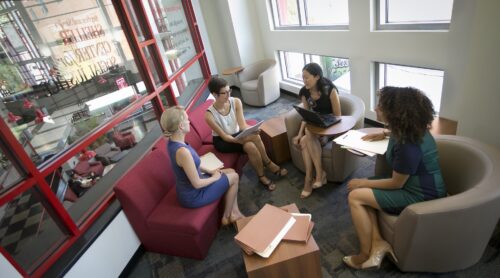
The Law School physical facilities have been transformed since 2000. The Klein Law Building, including the Law Library, has been significantly renovated to improve the lighting, the sound-proofing, furnishings, enhance technology and add more area for students to study. All lecture halls and seminar rooms have been renovated and include internet connections, electrical sources for student computers and smart classroom attributes for faculty teaching.
Recently, the Law School expanded the faculty with the addition of eleven full time professors. The addition of such talented individuals to our faculty is part of continued development in key areas of the law school's curriculum," said Dean Robert J. Reinstein.
On July 1, 2008 JoAnne A. Epps took over as the tenth Dean of the Law School.